Overnight Funds and Liquid Funds are both debt mutual funds, but they differ in the kind of securities they invest in and how long those securities take to mature. This article looks at both fund types in detail — but before that, a few terms are worth understanding, since they come up again and again when reading about these funds.
Key terms to know
TREPS (Tri-Party Repo)
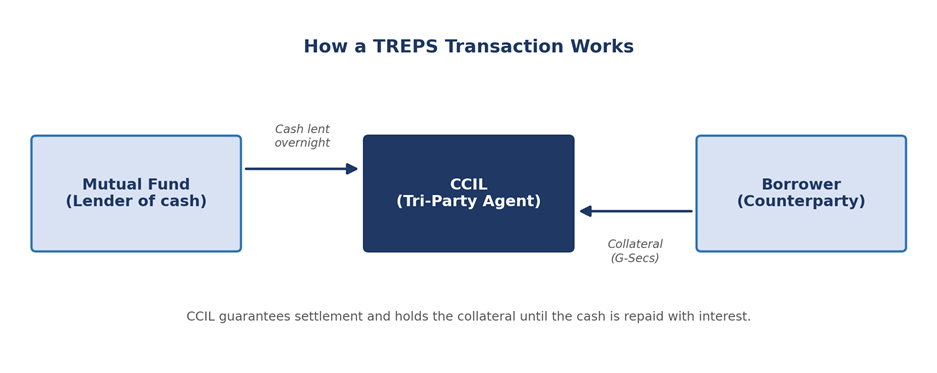
TREPS is a system where two parties borrow or lend money against government securities used as collateral, with a neutral third party managing the transaction. Here’s how it typically works:
- The third party is usually the Clearing Corporation of India Limited (CCIL).
- The borrower pledges low-risk bonds (such as government securities) to raise short-term cash.
- The CCIL handles the paperwork, checks the collateral value, and ensures settlement.
- If the borrower defaults, the CCIL sells the collateral to repay the lender.
- These transactions usually settle overnight, which makes TREPS highly liquid — and a natural fit for mutual fund portfolios.
Reverse Repo
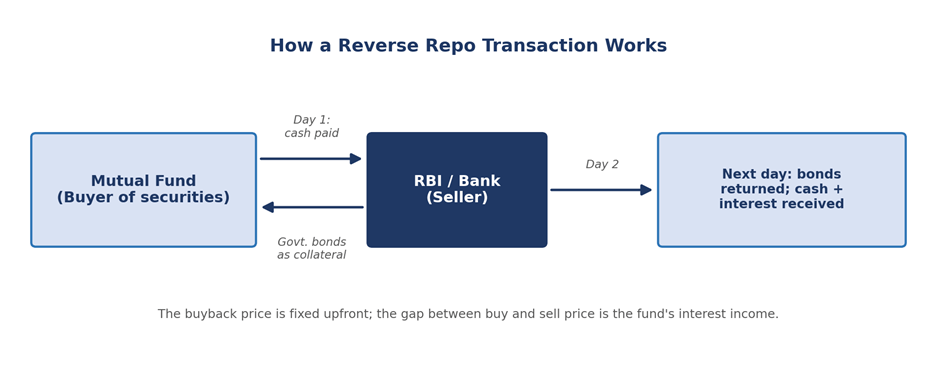
A reverse repo is an agreement where an institution buys securities from another party — often the central bank or a highly rated bank — with a promise to sell them back at a slightly higher price the next day.
- Mutual funds often execute reverse repos directly with the RBI or with highly rated banks.
- In the transaction, the fund receives high-quality government bonds as collateral against the cash it lends.
- The buyback price is fixed in advance, and the difference between the buy and sell price is the interest the fund earns.
- Central banks use this mechanism to absorb excess cash from the banking system.
Residual Maturity
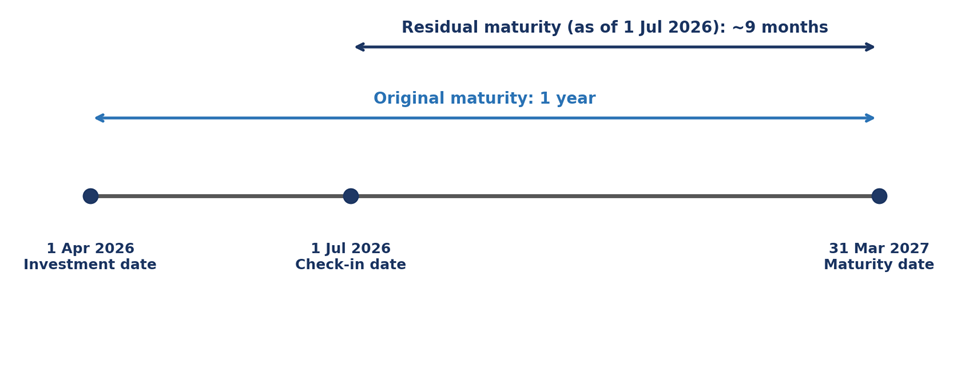
Residual maturity is the time remaining from the date of investment to the maturity of the security.
Example: A company issues a bond on 1 April 2026 that matures on 31 March 2027, giving it an original maturity of exactly 1 year.
- Original maturity: 1 year (1 April 2026 to 31 March 2027).
- If you check the same bond on 1 July 2026, three months — April, May, and June — have already elapsed since the date of investment.
- That leaves the period from 1 July 2026 to 31 March 2027, or about 9 months, still outstanding.
This remaining period — not the bond’s original 1-year tenor — is the residual maturity. The distinction matters in practice: SEBI’s maturity-based limits for schemes such as Overnight and Liquid Funds are applied on residual maturity, not on a security’s original maturity at issuance. So a bond originally issued with a 5-year tenor can still be held by an Overnight Fund once its residual maturity has run down to 1 day.
Money Market Instruments
Money market instruments are short-term debt securities that mature in one year or less. Common examples include Treasury Bills, Commercial Papers, and Call Money.
Overnight Fund
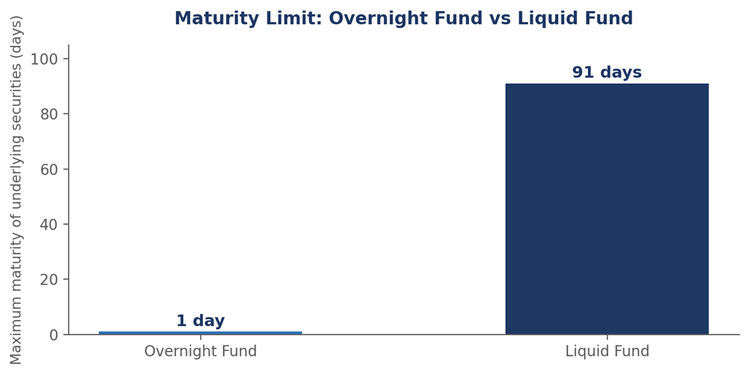
An Overnight Fund is an open-ended debt scheme that invests in overnight securities with a maturity of just one day. SEBI also permits these funds to deploy up to 5% of net assets in G-Secs and/or T-Bills with a residual maturity of up to 30 days, for specified margin or collateral purposes.
Overnight securities are debt or money market instruments with a maturity of just one day. These typically include:
- Overnight repo transactions
- Tri-Party Repo (TREPS)
- Other eligible overnight money-market instruments
Because the fund rolls over into fresh one-day securities every day, it earns the corresponding overnight return with very little price risk.
Liquid Fund
A Liquid Fund is an open-ended scheme that invests in debt and money market instruments with a maturity of up to 91 days. If units are redeemed within 7 days of investment, a graded exit load is levied.
For example, a Liquid Fund’s portfolio can hold a mix of instruments across maturities, such as:
- 7-day maturity
- 30-day maturity
- 60-day maturity
- 90/91-day maturity
Overnight Fund vs Liquid Fund
| Overnight Fund | Liquid Fund | |
| Maturity of underlying securities | 1 day | Up to 91 days |
| Interest-rate risk | Very low | Low |
| Typical use | Parking money for very short periods (a day or two) | Short-term parking, typically a few days to a few weeks |
| Return potential | Generally lower | Generally slightly higher |
| Exit load | Usually nil | Graded exit load if redeemed within 7 days |
Taxation of Overnight and Liquid Funds
As per Section 76 of the Income-tax Act, 2025, gains from a ‘Specified Mutual Fund’ — a category that covers most debt-oriented funds, including Overnight and Liquid Funds — on transfer, redemption, or maturity are treated as short-term capital gains, irrespective of the holding period. These gains are taxed at the applicable slab rate for individuals, and at the applicable rate for other categories of taxpayers.
This treatment applies only where the units were acquired on or after 1 April 2023. For units acquired before that date, the earlier short-term/long-term capital gains provisions continue to apply.
Example (step by step):
Step 1: Investment — An investor invests ₹1,00,000 in an Overnight or Liquid Fund on 1 April 2026.
Step 2: Redemption — The investor redeems the entire investment for ₹1,80,000 on 31 March 2029.
Step 3: Holding period — The units were held for exactly three years (1 April 2026 to 31 March 2029).
Step 4: Capital gain — Gain = Redemption value − Investment cost = ₹1,80,000 − ₹1,00,000 = ₹80,000.
Step 5: Check the general rule — Ordinarily, a debt-oriented capital asset held for more than 24 months would qualify for long-term capital gains treatment at a lower, concessional rate.
Step 6: Apply Section 76 — Since these units qualify as a ‘Specified Mutual Fund’ under Section 76 of the Income-tax Act, 2025, and were acquired on or after 1 April 2023, this general rule is overridden — the entire ₹80,000 gain is treated as a short-term capital gain, irrespective of the three-year holding period.
Step 7: Tax computation — The ₹80,000 gain is added to the investor’s total taxable income for the year and taxed at their applicable income-tax slab rate. No indexation benefit is available, and no flat concessional long-term rate applies — unlike what would apply to a similar equity investment, or to debt fund units acquired before 1 April 2023.
Conclusion
Both Overnight and Liquid Funds can be considered for parking surplus money for a short period. They can be a useful alternative to keeping excess cash idle in a savings account, especially when the money is not required immediately.
The choice between the two mainly depends on when you are likely to need the money. If the investment is for just a few days, an Overnight Fund may be more suitable. If you can stay invested for a slightly longer period, a Liquid Fund may be worth considering.
In the end, there is no one-size-fits-all choice. It comes down to your investment period, liquidity needs and comfort with the risks involved. For short-term surplus cash, both funds can have a role to play when used appropriately.
FAQs
1. What is an Overnight Fund as per SEBI?
An Overnight Fund is an open-ended debt scheme investing in overnight securities having a maturity of 1 day.
2. What is a Liquid Fund as per SEBI?
A Liquid Fund is an open-ended scheme investing in debt and money-market securities with a maturity of up to 91 days.
3. What is the main difference between Overnight and Liquid Funds?
The key difference is the maturity of the underlying investments: an Overnight Fund holds securities maturing in 1 day, while a Liquid Fund can hold securities maturing in up to 91 days. As a result, Overnight Funds generally carry lower interest-rate risk than Liquid Funds.
4. Are Overnight Funds completely risk-free?
No. An Overnight Fund is not a guaranteed-return or risk-free product. While the very short maturity substantially limits interest-rate risk, the fund remains subject to risks associated with its underlying investments and transactions. SEBI describes an Overnight Fund as having relatively low interest-rate and credit risk, rather than zero risk.
5. Can a Liquid Fund invest in securities with a maturity of more than 91 days?
Generally, no. Under SEBI’s scheme categorisation, Liquid Funds are required to invest in debt and money-market securities with a maturity of up to 91 days.
6. What type of securities can Overnight Funds invest in?
An Overnight Fund invests in eligible overnight securities with a 1-day maturity, such as overnight repo and Tri-Party Repo (TREPS) transactions. The key requirement is that the investment must satisfy the applicable overnight maturity norm — an Overnight Fund cannot simply hold a CP, CD, or T-Bill regardless of its maturity.
7. Do Liquid Funds carry higher risk than Overnight Funds?
Generally, yes. Because a Liquid Fund can hold securities with maturities extending up to 91 days, it can carry somewhat greater interest-rate and credit/liquidity exposure than an Overnight Fund. SEBI has specifically distinguished the two categories on the basis of their maturity profile.
8. Are returns from Overnight Funds guaranteed?
No. SEBI does not guarantee the returns of any mutual fund scheme. The scheme’s investment objective normally carries a disclaimer that there is no assurance the stated objective will be achieved.
9. Which fund is more suitable for very short-term parking?
From a maturity and interest-rate-risk perspective, an Overnight Fund is generally more suitable for very short-term parking, since its underlying securities mature in a single day. A Liquid Fund may suit investors who want short-term parking but don’t need the portfolio restricted to one-day securities.
10. Does “Liquid Fund” mean the money can be withdrawn instantly?
Not exactly. “Liquid” describes the nature of the scheme and its underlying investments — it doesn’t mean guaranteed instant access to money under every circumstance. Normal redemption cut-off times, settlement timelines, and other applicable scheme provisions continue to apply.


Leave a Reply