Introduction
A mutual fund is an investment vehicle that pools money from a large number of investors by issuing them units. This pooled corpus is then invested across various securities available in the market, and the investments are managed by qualified, SEBI-registered fund managers on behalf of the investors.
How It Works
A mutual fund collects money from investors and invests it in different types of securities, ranging from equity shares and debentures to money market instruments, depending on the scheme’s stated investment objective. The income earned through these investments, along with any capital appreciation the scheme realizes, is passed back to investors in proportion to the number of units each of them holds.
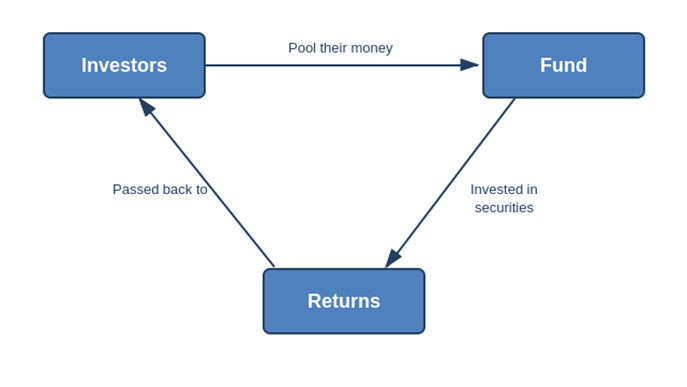
The mutual fund cycle: investors pool their money into the fund, which is invested in securities, and the resulting returns are passed back to investors.
Advantages of Investing in Mutual Funds
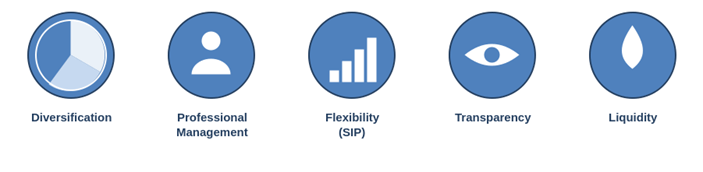
- Diversification: Money is spread across a range of securities, which helps reduce concentration risk compared with holding a single stock or bond.
- Professional Management: Investments are handled by SEBI-registered fund managers who track markets and make decisions on the investors’ behalf.
- Flexibility: Investors can start small and invest regularly through a Systematic Investment Plan (SIP). Most SIPs begin at around ₹500 a month, and a growing number of schemes now offer “micro-SIPs” starting from ₹100–₹250, in line with SEBI’s push for smaller ticket sizes.
- Transparency: Fund houses are required to disclose NAV, portfolio holdings, expenses, and performance regularly, so investors can track exactly where their money is invested.
- Liquidity: Open-ended schemes let investors redeem units, partially or fully, on any business day at the prevailing NAV. Close-ended schemes are less liquid and are typically exited by selling on a stock exchange or through periodic repurchase windows.
Classification of Mutual Funds
1. By Structure (Maturity Period)
- Open-Ended Funds: Investors can enter or exit at any time, buying and selling units at the NAV declared by the fund.
- Close-Ended Funds: Units can be bought only during the New Fund Offer (NFO). These schemes have a fixed maturity period and are listed on stock exchanges, where SEBI regulations require the fund to offer at least one exit route: listing on an exchange, periodic repurchase, or both.
- Interval Funds: A mix of the two — units can be bought or sold only during specified transaction windows, such as monthly, quarterly, or annually.
2. By Investment Objective (SEBI Categorisation)
Under SEBI’s 2017 categorisation and rationalisation circular, all mutual fund schemes are grouped into five broad categories, with 36 sub-categories in total:
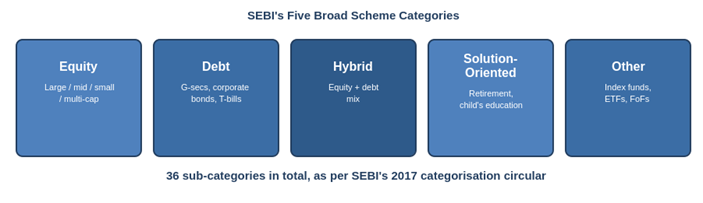
- Equity Funds: Invest mainly in equity and equity-related instruments, and are sub-categorized by market capitalization into large-cap, mid-cap, small-cap, and multi-cap, among others. Best suited for long-term wealth creation, with comparatively higher risk.
- Debt Funds: Invest in fixed-income instruments such as government securities, corporate bonds, and treasury bills, categorized by the maturity and credit quality of the underlying paper. These carry lower risk and aim for stable returns.
- Hybrid Funds: Split investments between equity, debt, and sometimes other assets, in varying proportions — e.g., conservative, balanced, or aggressive hybrid funds — to balance risk and return.
- Solution-Oriented Funds: Designed for specific goals, such as retirement or a child’s education, and typically come with a lock-in period.
- Other Funds: Includes passively managed schemes such as index funds, Exchange Traded Funds (ETFs), and Fund of Funds (FoFs).
3. By Ownership of the Sponsoring Entity
- Public Sector Mutual Funds: Sponsored by a public sector company or bank — for example, SBI Mutual Fund and PNB Mutual Fund.
- Private Sector Mutual Funds: Sponsored by a company from the private sector — for example, HDFC Mutual Fund and ICICI Prudential Mutual Fund.
- Foreign-Sponsored Mutual Funds: Sponsored by a foreign entity that raises and invests funds within India — for example, Franklin Templeton Mutual Fund.
Note: Mutual fund investments are subject to market risks. Please read the scheme-related documents carefully before investing. For verified information and to check whether a fund is SEBI-registered, refer to http://www.sebi.gov.in.


Leave a Reply