While the macro framework of the Union Budget 2026-27 lays the foundation for capital-led growth, the real transmission of growth into employment and income generation lies in MSMEs, sectoral expansion, and enterprise creation. In this regard, the Budget presented by Nirmala Sitharaman makes a conscious attempt to strengthen the productive backbone of the economy, rather than relying solely on large corporates or headline infrastructure projects.
From a Chartered Accountant’s perspective, this Budget is notable for its depth and breadth of sectoral interventions, particularly for MSMEs, manufacturing, tourism, agriculture, creative industries, and regional development.
1. MSMEs at the Core of the Growth Strategy
The Budget places MSMEs not as beneficiaries of welfare, but as drivers of industrial revival and employment generation.
Revival of Legacy Industrial Capacity
- Proposal to revive 200 legacy industrial clusters across the country
This move is structurally significant, as it focuses on: - Re-utilisation of existing industrial infrastructure
- Revival of regional manufacturing hubs
- Employment generation without heavy greenfield capex
MSME Champion Programme & Professional Support
- Introduction of MSME Champion Programme
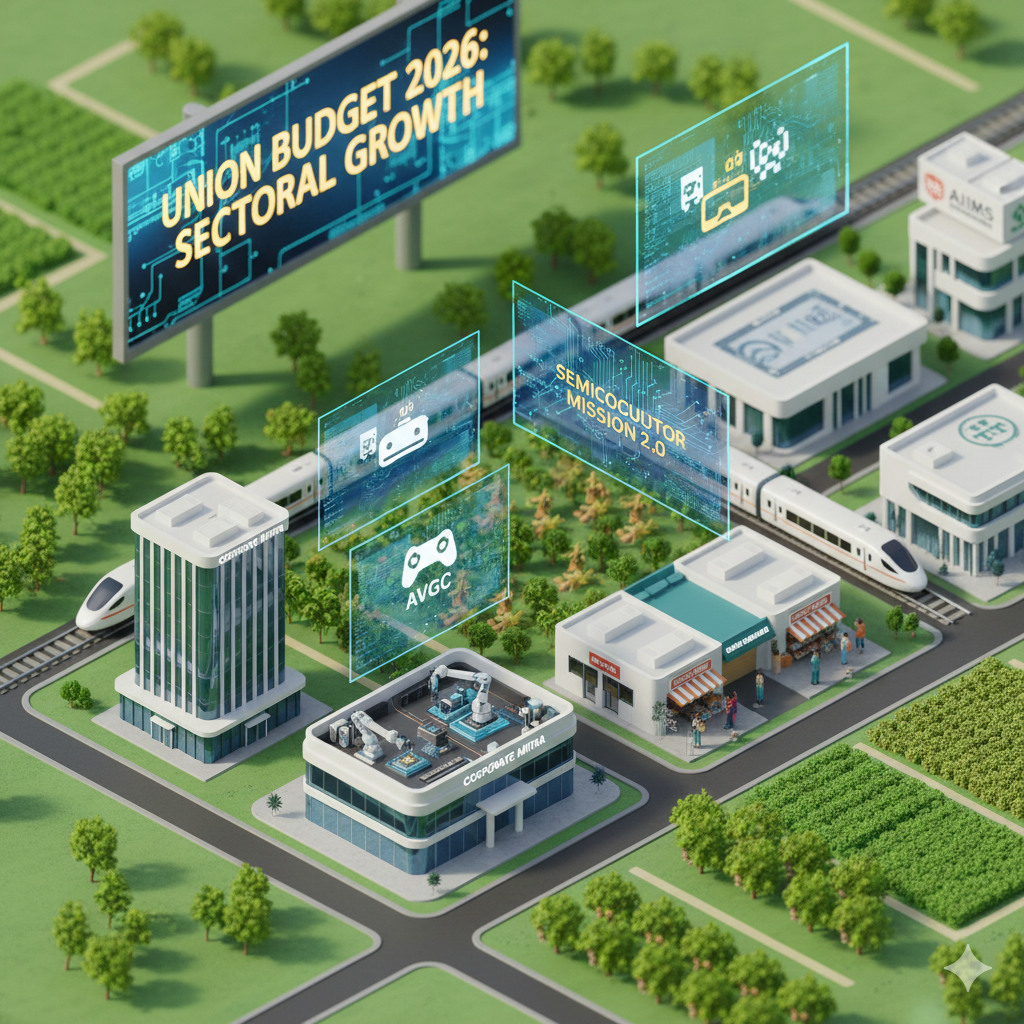
- Launch of “Corporate Mitra” – professional and consultancy support at affordable cost
This marks a shift from mere credit support to capability-building, addressing long-standing MSME pain points such as:
- Compliance complexity
- Financial structuring
- Governance and scalability
Liquidity, Equity & Market Access
- ₹10,000 crore SME Growth Fund
- Liquidity support and equity programmes
- Expansion of TReDS platform to enable faster settlement of MSME dues by CPSEs
From a CA’s lens, this is critical in improving:
- Cash flow predictability
- Working capital cycles
- Balance sheet resilience
2. Manufacturing Push: Moving Up the Value Chain
Semiconductors & Electronics
- ₹40,000 crore allocation for Semiconductor Manufacturing – Semiconductor Mission 2.0
- Electronic Components Manufacturing Scheme
This reinforces India’s ambition to move beyond assembly into deep-tech manufacturing, supply chain integration, and global competitiveness.
Pharma, Chemicals & Self-Reliance
- Bio-Pharma Shakti – ₹10,000 crore
- Establishment of 3 chemical parks
- Self-Reliant India Fund top-up of ₹2,000 crore
These measures strengthen domestic manufacturing capabilities while reducing import dependence in critical sectors.
Textiles & Sports Manufacturing
- Expansion of Mega Textile Parks for value addition
- Dedicated initiative for sports goods manufacturing
These sectors are labour-intensive and have strong export potential, making them key contributors to inclusive growth.
3. Agriculture & Allied Sectors: From Subsistence to Value Creation
The Budget reflects a shift in agricultural policy from volume-driven production to high-value and productivity-focused agriculture.
Key initiatives include:
- Support for high-value agriculture
- Coconut promotion scheme to enhance productivity
- Dedicated programme for Indian cashew to achieve self-reliance in raw cashew production
- Government partnership with States to promote sandalwood cultivation
- Proposal to roll out loan-linked capital subsidy support for veterinary hospitals
These measures directly impact:
- Farmer incomes
- Agri-processing industries
- Rural entrepreneurship
4. Tourism, Culture & Experience Economy
Tourism is treated as a multi-sector economic engine, not merely a cultural activity.
Destination & Circuit Development
- Development of 15 archaeological sites into experiential cultural destinations
- Creation of 5 tourism destinations in Purvodaya States
- Launch of Buddhist Circuit development in the North-Eastern region
Experiential & Niche Tourism
- Development of railway and hiking experiences in hilly areas
- Proposal for a pilot scheme to skill 10,000 tourist guides across 20 tourist sites, in collaboration with IIMs
This approach integrates:
- Local employment
- MSME participation
- Service sector growth
5. Creative Economy, Sports & Knowledge Infrastructure
The Budget recognises the growing economic contribution of creative industries, sports, and digital content.
Key proposals include:
- Establishment of AVGC (Animation, Visual Effects, Gaming & Comics) content creation labs in schools and colleges
- Support to Indian Institute of Creative Technology, Mumbai
- Launch of Khelo India Mission to transform the sports sector over the next decade
- Dedicated initiatives for sports infrastructure and goods manufacturing
This reflects a shift towards new-age employment avenues, particularly for youth.
6. Education, Healthcare & Human Capital Ecosystem
Healthcare & Allied Professions
- Creation of allied health professionals through upgradation of existing institutions
- Establishment of five regional medical hubs in partnership with the private sector
- Proposal to set up three new All India Institutes of Ayurveda
- Expansion of emergency and trauma care centres
- Upgradation of NIMHANS and National Mental Health Institutes at Ranchi and Tezpur
Education Infrastructure
- Creation of five university townships along major industrial and logistics corridors
- Establishment of one girls’ hostel in every district
- Upgradation of telescope infrastructure facilities
- Establishment of National Institute of Hospitality
These initiatives link education directly with employability, regional development, and social inclusion.
7. Social Enterprise & Inclusion-Oriented Growth
The Budget continues its emphasis on inclusive entrepreneurship:
- Self-help entrepreneur marts (on the lines of SHE Marts) as community-owned retail outlets for rural women
- Divyangjan Kaushal Yojana to ensure dignified livelihood opportunities for persons with disabilities
- Divyangjan Sahara Yojana to improve access to high-quality assistive devices
These initiatives integrate social welfare with enterprise creation, rather than long-term dependency.
8. Focus on Purvodaya & North-Eastern Region
Regional balance is a recurring theme:
- Dedicated focus on Purvodaya States
- Development of five tourism destinations in five Purvodaya States
- Infrastructure, tourism, and cultural connectivity in the North-East
This aligns with the broader goal of balanced regional economic growth.
9. Technology & Digital Public Infrastructure
- Proposal to launch Bharat Vistar, a multilingual AI tool
- Creation of a National Destination Digital Knowledge Grid
These initiatives strengthen India’s digital public infrastructure while enhancing accessibility and inclusiveness.
10. Concluding CA Perspective
From a Chartered Accountant’s viewpoint, Union Budget 2026-27 makes a clear statement:
Growth will be driven by enterprises, MSMEs, sectoral depth, and regional inclusion, not by short-term fiscal stimulus.
The Budget:
- Strengthens MSME capability, not just credit
- Pushes manufacturing beyond assembly
- Recognises tourism and creative industries as serious economic contributors
- Aligns agriculture, education, and healthcare with enterprise creation
 Stox N Tax
Leave a comment