By Stox n Taxes Editorial | October 2025
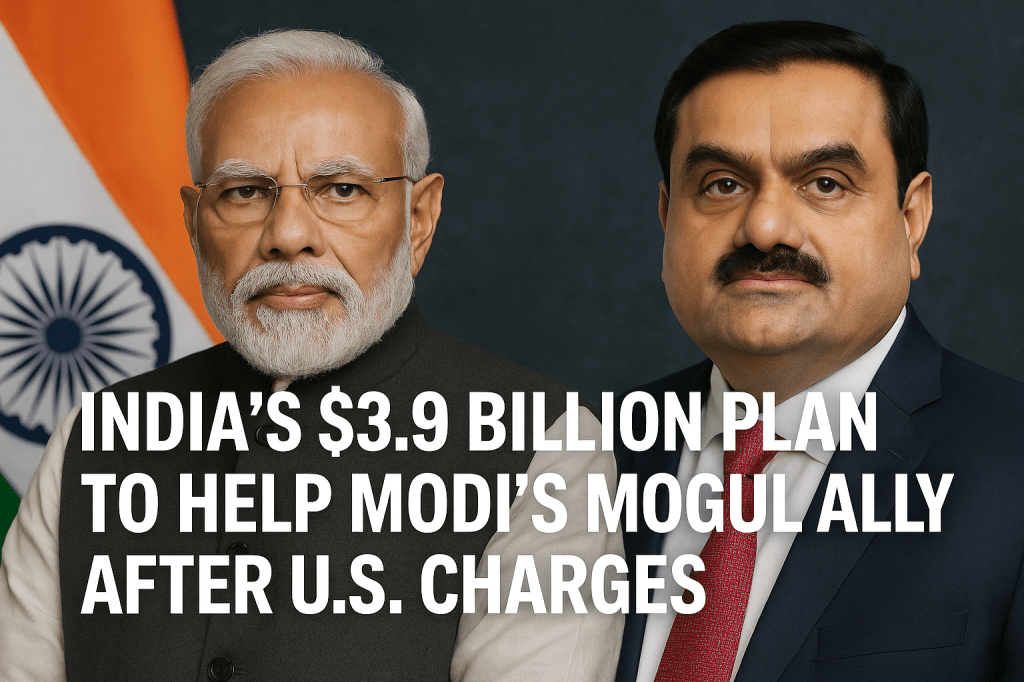
In a major revelation that’s creating ripples across India’s financial markets, reports suggest that the Government of India has quietly formulated a $3.9 billion (approx. ₹32,000 crore) plan to extend support to the Adani Group through the state-owned Life Insurance Corporation of India (LIC).
The move comes amid serious U.S. legal charges against the conglomerate led by billionaire Gautam Adani, raising sharp questions over governance, risk exposure, and public fund utilization.
🔍 What the report reveals
According to documents reviewed by The Washington Post, the plan—drafted by the Finance Ministry’s Department of Financial Services (DFS)—directed LIC to inject funds into Adani subsidiaries through both bonds and equity purchases.
- Around $3.4 billion was allocated for bond investments.
- Roughly $500 million targeted equity infusions.
- The first instance was a $585 million Adani Ports bond issue, fully financed by LIC on May 30, 2025.
- The plan’s internal note described its goal as “signalling confidence in Adani Group and stabilizing market sentiment.”
At that time, Adani Group’s debt had ballooned over 20% in one year, while foreign lenders grew cautious following the U.S. Department of Justice (DOJ) and SEC investigations alleging multi-billion-dollar investor fraud.
🏦 Why the LIC connection matters
LIC, India’s largest insurer with policyholders across the nation, is primarily entrusted to safeguard citizens’ savings. Directing it to invest billions into a single corporate group facing global legal challenges raises governance and fiduciary concerns.
Critics warn that if Adani’s financial condition deteriorates, public money could face severe risk. On the other hand, government officials reportedly view Adani as a strategic player essential for India’s infrastructure growth.
⚖️ The controversy deepens
The Adani Group, already under a global spotlight since the Hindenburg Research report of 2023, is again facing scrutiny. The U.S. DOJ charges accuse the group of misleading investors and bribing officials to win major contracts.
With global banks tightening credit lines, the reported state-backed lifeline could be critical for the group’s short-term liquidity—but at a significant reputational cost for the Indian government and its financial institutions.
📉 Market & policy implications
1. Investor sentiment:
State intervention in corporate financing could unsettle foreign investors who prefer independent market-driven mechanisms.
2. LIC’s credibility:
The insurer’s policyholders and shareholders may demand transparency on exposure to Adani-linked securities.
3. Political optics:
With elections approaching, the opposition is likely to project this as “crony capitalism”—government favoring corporate allies.
4. Economic policy line:
It blurs the distinction between industrial policy (supporting national champions) and public fund protection (ensuring prudent investment).
🔭 What happens next
- LIC’s upcoming annual disclosure will be closely examined for new Adani investments.
- Any SEBI or CAG probe could reshape the narrative around public sector accountability.
- The U.S. legal proceedings will determine how much operational and financial risk Adani faces abroad.
- The bond and equity performance of Adani firms will signal whether markets view this support as stabilizing—or politically driven.
💬 FAQs — India’s $3.9 Billion Adani Support Plan
Q1. What exactly is the $3.9 billion plan?
It’s a reported government-backed proposal directing LIC and other state financial institutions to invest around $3.9 billion in Adani Group companies via bonds and equity purchases.
Q2. Why is this plan controversial?
Because Adani Group faces U.S. criminal and civil charges for alleged investor fraud, raising questions about why Indian public money is being used to support it.
Q3. What role does LIC play here?
LIC is India’s largest insurer, managing trillions in public savings. Its investments are meant to be safe and diversified; exposure to a single corporate group of this magnitude is unusual.
Q4. Has the government confirmed this plan?
As of now, there’s no official confirmation. The report is based on leaked internal documents reviewed by The Washington Post.
Q5. How could this affect Adani Group’s share prices?
Short-term, government-linked investment could boost investor confidence. Long-term, the outcome of the U.S. legal cases will likely determine share stability.
Q6. What’s at risk for Indian investors?
If Adani’s assets lose value or face penalties abroad, LIC’s heavy exposure could impact its returns, indirectly affecting millions of policyholders and mutual fund investors.
Q7. What do analysts expect next?
Analysts are watching for any official clarification, SEBI intervention, and how global credit agencies respond to Adani’s evolving debt profile.
🧭 Stox n Taxes Insight
This case underscores a vital takeaway:
When public money meets private power, transparency is non-negotiable.
For Indian investors, the Adani–LIC episode is a reminder to track not just profits, but policy—because in India’s evolving economy, government strategy often moves the markets.
 Stox N Tax
Leave a comment