Introduction
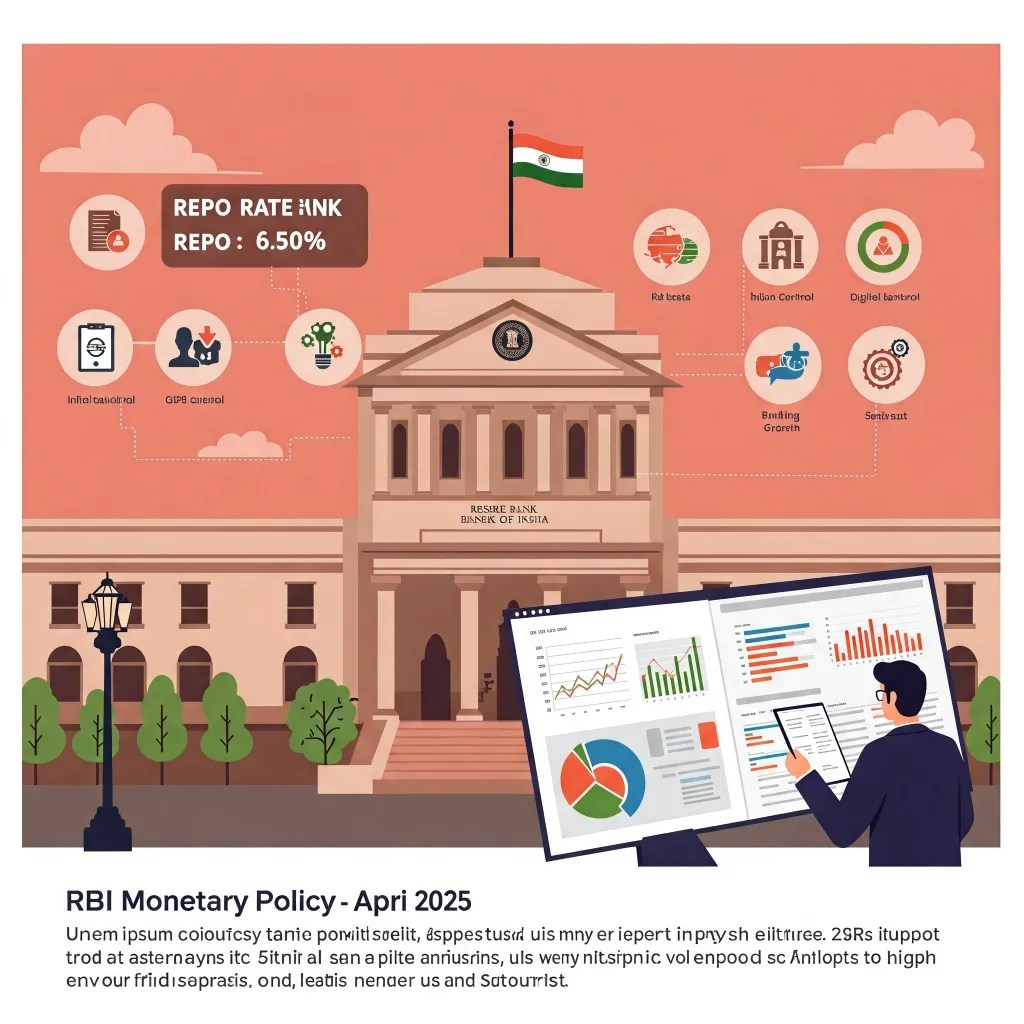
The Reserve Bank of India (RBI) has, through its Monetary Policy Committee (MPC) meeting held on 5th April 2025, signaled continuity with cautious optimism. In an evolving global environment marked by disinflation, volatile oil prices, and evolving geopolitical tensions, the RBI has opted to keep the repo rate unchanged at 6.50%, retaining its ‘withdrawal of accommodation’ stance.
This article offers a comprehensive, professional analysis of the policy rationale, sectoral implications, and fiscal impact of the monetary policy update, while contextualizing it within India’s macroeconomic framework, inflation trajectory, and global financial stability outlook.
I. Policy Highlights at a Glance
| Instrument | Rate (% p.a.) |
|---|---|
| Repo Rate | 6.50 |
| Standing Deposit Facility | 6.25 |
| Marginal Standing Facility | 6.75 |
| Bank Rate | 6.75 |
| CRR (Cash Reserve Ratio) | 4.50 |
| SLR (Statutory Liquidity Ratio) | 18.00 |
Stance: Withdrawal of accommodation
Voting Outcome: 5:1 majority in favor of status quo
II. Rationale Behind the Policy
1. Inflation Moderation, Yet Sticky Food Prices
While headline CPI inflation has eased to an average of 5.1% in FY 2024-25, core inflation has remained within a comfortable band. However, food inflation remains a concern, primarily due to weather-related disruptions in supply chains, particularly in perishables.
RBI aims to bring inflation closer to the medium-term target of 4%, with projections as follows:
- Q1 FY 2025-26: 5.0%
- Q2 FY 2025-26: 4.2%
- Q3 FY 2025-26: 4.7%
- Q4 FY 2025-26: 4.5%
2. Support for Growth with Monetary Prudence
- Real GDP growth for FY 2024-25 clocked 7.6%, exceeding expectations.
- Forecast for FY 2025-26 remains optimistic at 7.0%, buoyed by strong urban demand, pick-up in rural recovery, private capex, and robust manufacturing.
The unchanged repo rate signals that the RBI seeks to support growth momentum while remaining watchful of second-round inflationary pressures.
III. Liquidity Management Strategy
The RBI has emphasized the need to keep system liquidity near-neutral, ensuring:
- No excess liquidity that could fuel inflation
- Adequate flow of credit to productive sectors
- Smooth transmission of past rate hikes
Tools deployed include:
- Variable Rate Reverse Repo (VRRR) operations
- Open Market Operations (OMO) and G-sec acquisitions
- Standing Deposit Facility (SDF) as the primary tool to absorb surplus funds
IV. Sector-Wise Impact Analysis
A. Banking and Financial Sector
- Lending rates are expected to remain steady in the short term.
- Deposit rate competition may intensify as banks aim to shore up CASA balances.
- Transmission of past rate hikes has largely occurred, with MCLR and repo-linked loan rates stabilizing.
B. MSMEs and Corporates
- Status quo benefits MSMEs with existing loans.
- For new credit, RBI’s liquidity neutral stance may prevent further hardening of rates.
- Corporates with large working capital exposures and ECB borrowings get a reprieve from additional borrowing costs.
C. Real Estate & Housing Finance
- Home loan borrowers benefit from EMI stability.
- Affordable housing may see further revival, especially with state-led housing missions.
- NBFCs and HFCs may see improved cost predictability, aiding retail disbursals.
D. Equity and Capital Markets
- Stock markets have responded positively, pricing in a potential rate cut later in FY26.
- The policy supports domestic growth themes, encouraging FPI inflows.
V. Macroeconomic Indicators – Anchoring the Policy
| Indicator | Current Level |
|---|---|
| CPI Inflation (Mar 2025) | 5.1% |
| WPI Inflation | 2.2% |
| Forex Reserves | USD 645 billion |
| Rupee vs USD (avg) | ₹82.75 |
| Fiscal Deficit (RE FY25) | 5.8% of GDP |
| Current Account Deficit (CAD) | 1.2% of GDP |
| Unemployment Rate (CMIE est.) | 7.4% |
VI. Regulatory Measures Announced Alongside
1. Auto-Replenishment of UPI Wallets
- Enhanced interoperability between wallets and bank accounts using standing instructions.
- This move is expected to enhance digital payments adoption, especially for recurring payments.
2. Review of Bulk Deposit Limits
- RBI proposes greater uniformity in defining “bulk deposits” across banks to reduce regulatory arbitrage and enhance rate transparency.
3. Fintech Regulations and Sandbox Expansion
- The central bank reaffirmed its commitment to fintech innovation within regulated boundaries, with expanded scope for regulatory sandboxes.
VII. What Should Businesses and CFOs Do Now?
✔ For Treasury Heads and CFOs
- Lock in favorable debt terms before any uptick.
- Monitor RBI liquidity absorption and OMO signals.
- Reassess working capital forecasts in light of steady rates.
✔ For Investors and Finance Heads
- Consider rate-sensitive instruments (bonds, REITs) for steady yields.
- Stay tuned to fiscal announcements for infrastructure and capex-linked tax incentives.
✔ For Exporters and Importers
- Forex stability provides a hedging window.
- Evaluate forward contracts as rupee is expected to remain in ₹82–₹84 range short-term.
VIII. Global Context and Forward Guidance
Global Central Bank Trends:
- US Fed: Paused rates; eyes 2–3 cuts in CY25.
- ECB & BoE: Neutral stance; waiting for more disinflation.
- Asian Central Banks: Following India’s lead on rate stability.
RBI’s Forward Guidance:
- RBI reiterated its commitment to being data-driven and nimble.
- A rate cut may be considered only if inflation cools sustainably to ~4%.
Conclusion
The RBI’s April 2025 policy strikes a delicate yet necessary balance. By holding the repo rate steady at 6.5% and signaling prudent liquidity management, the central bank has chosen stability over surprise. This provides businesses, investors, and consumers the certainty they need to plan financial strategies, investments, and capital expansion.
For India, maintaining price stability while nurturing its aspirational GDP target of 7%+ is crucial. RBI’s policy reflects precisely that — a central bank cautious in movement, yet committed in direction.
 Stox N Tax
Leave a comment