Introduction
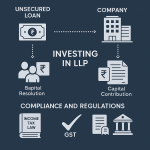
In the evolving Indian business environment, hybrid investment and ownership models have become increasingly common. One such scenario involves a company desiring to invest in a Limited Liability Partnership (LLP), particularly by raising unsecured loans from outsiders. This article presents a comprehensive analysis of the feasibility and legality of such an arrangement under various Indian legislations including the Companies Act, 2013, the Income Tax Act, 1961, the CGST Act, 2017, FEMA regulations, and relevant judicial and regulatory interpretations.
1. Companies Act, 2013 – Legal and Compliance Framework
1.1 Investment in LLP: Section 186
Section 186 of the Companies Act, 2013 governs inter-corporate loans and investments:
- A company is permitted to invest in LLPs unless explicitly restricted by its Articles of Association.
- Limits: Without shareholder approval, investments cannot exceed:
- 60% of paid-up share capital + free reserves + securities premium, or
- 100% of free reserves + securities premium, whichever is higher.
- If investment exceeds these limits, a special resolution of shareholders is required [Section 186(3)].
1.2 Exceptions to Section 186
- Private Limited Companies that are not subsidiaries of public companies and meet prescribed thresholds may be exempt.
- Banking and Insurance companies are generally exempt for investments in the ordinary course of business.
1.3 Board Resolution and Disclosure
- A board resolution must be passed approving the investment.
- Register of Investments to be maintained in Form MBP-4.
- Proper disclosures in the financial statements.
1.4 Section 185 – Loans to Directors and Related Entities
- Investment should not indirectly benefit directors or related parties, otherwise Section 185 is attracted.
- If the LLP includes company directors or relatives as partners, ensure compliance by obtaining prior approval and passing a special resolution with justification.
1.5 Section 73 & 76 – Acceptance of Unsecured Loans
- A private company may accept unsecured loans from persons not being directors, provided:
- It is not a subsidiary of a public company;
- It complies with Companies (Acceptance of Deposits) Rules, 2014.
- Proper documentation and board approval is essential.
2. Income Tax Act, 1961 – Tax Implications and Risks
2.1 Interest Deductibility – Section 36(1)(iii)
- Interest on borrowed capital is deductible if borrowed funds are used for the purpose of business.
- If the LLP is engaged in activities not related to the company’s business, disallowance may occur.
2.2 Capital vs Revenue Nature
- Investment in LLP is capital in nature; any interest expense on loans used to make such capital investment may be disallowed under Section 37 unless a clear nexus to business objective is demonstrated.
2.3 Section 40A(2)(b) – Related Party Transactions
- If the LLP is a related party, any transactions (like interest, rent, royalty) between company and LLP must be at arm’s length.
2.4 Transfer Pricing (Sections 92 to 92F)
- If any international transactions exist between the company and LLP, TP documentation and arm’s length pricing are mandatory.
2.5 GAAR (General Anti Avoidance Rules)
- If the arrangement is a colorable device to avoid taxes, GAAR may be invoked by the department under Chapter X-A.
3. GST Implications – CGST Act, 2017
3.1 Investment in LLP is Not a Supply
- A capital contribution to an LLP is not considered supply and hence, not liable to GST.
3.2 Interest on Unsecured Loans
- As per Entry No. 27 of Notification 12/2017-Central Tax (Rate), interest on loans is exempt from GST.
- Accordingly, the company will not charge GST on interest received if it lends money to the LLP.
3.3 ITC Reversal
- Since the company is involved in making exempt supplies (interest income), Rule 42 of CGST Rules may require proportionate reversal of ITC unless fully used for taxable outward supplies.
3.4 Related Party Transactions
- If the company and LLP are related entities, and any services are supplied between them, GST may apply even if supplied without consideration (Schedule I).
4. LLP Act, 2008 – Partner Contribution and Rights
4.1 Company as Partner
- A company is legally permitted to become a partner in an LLP.
- LLP Agreement must be amended to include the company as a partner and specify the nature and quantum of contribution.
4.2 Capital Contribution
- Contribution can be in the form of cash or in kind, subject to valuation.
- Disclosure to be made in LLP Form 3 (amendment in LLP Agreement).
4.3 Profit Sharing and Withdrawal
- The LLP agreement must clearly define profit-sharing ratio, rights, and exit mechanism.
- Withdrawal of capital should be in line with LLP agreement and subject to solvency.
5. FEMA & FDI Considerations
5.1 Foreign Investment in LLP
- FDI in LLP is permitted under automatic route in sectors where 100% FDI is allowed and no FDI-linked conditions exist.
- However, downstream investment by an Indian company having foreign investment into an LLP must also follow sectoral caps and conditions.
5.2 ECB (External Commercial Borrowings)
- If the company proposes to raise funds from abroad to invest in LLP, ECB regulations apply.
- ECB funds cannot be used for equity investments or capital contributions into LLPs.
6. Practical Compliance Checklist
| Compliance Item | Required? | Remarks |
|---|---|---|
| Board Resolution | Yes | For accepting loan and investing in LLP |
| Shareholder Resolution | Conditional | Required if Sec 186(3) threshold exceeded |
| Loan Agreement | Yes | Between company and lenders (outsiders) |
| Amendment to LLP Agreement | Yes | To reflect new partner contribution |
| ROC Filings (MGT-14) | Conditional | Required for SR under Sec 186 |
| MBP-1 and MBP-2 disclosures | Yes | Directors’ interest in LLP to be disclosed |
| ITC Reversal under GST | Conditional | If exempt interest income is earned |
| TP Documentation | Conditional | If international related party transactions exist |
7. Judicial Precedents and Guidance
- CIT vs. Core Health Care Ltd. (SC) – Upheld interest deductibility under Sec 36(1)(iii) for capital borrowed for business expansion.
- Circulars by MCA – Clarified that companies can invest in LLPs under Sec 186.
- CBDT Circular No. 10/2017 – Specified disallowance of interest on capital borrowed for investments in non-business activities.
Conclusion
While there is no statutory bar on a company investing in an LLP using borrowed funds, due diligence, proper structuring, and documentation are critical. The investment must be commercially justified and legally compliant with the Companies Act, Income Tax Act, and GST laws. It is advisable to assess the substance over form, ensure commercial rationale, and adopt transparent governance to avoid future scrutiny.
Disclaimer
This article is intended for informational purposes only and should not be construed as legal or tax advice. Readers are advised to consult professionals before acting on any matter contained herein.
 Stox N Tax
Leave a comment