Why the enforcement matters, how the 30% crypto tax works, and steps to get compliant
Overview of the Notice Campaign
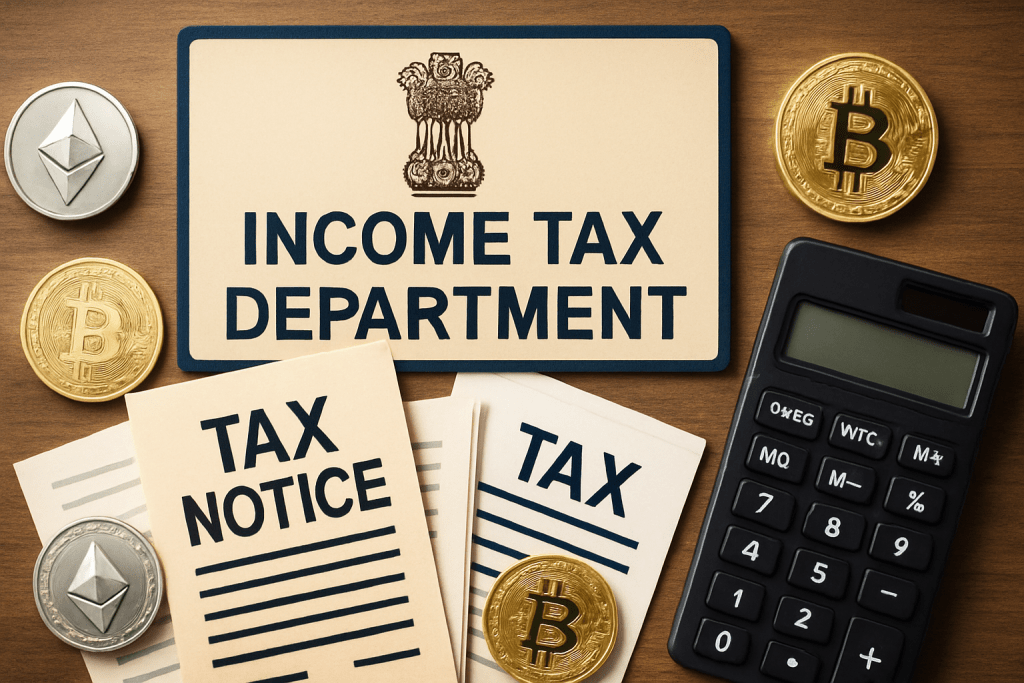
On August 8, 2025, India’s Income Tax Department issued over 44,000 notices to cryptocurrency traders for failing to disclose their virtual digital asset (VDA) income in tax filings—a clear signal that crypto taxation is being strictly enforced. This crackdown follows extensive data gathering from exchanges and analytics tools to identify non-compliance.
What the Law Says
Under Section 115BBH of the Income Tax Act, income from VDA transfers (including cryptocurrencies and NFTs) is taxed at a flat 30%, with no deductions except for cost of acquisition. Additionally, a 1% TDS applies to crypto transfers under Section 194S. Losses from crypto trading cannot be offset against other income or carried forward, making the tax regime stricter compared to stocks.
Why the Crackdown Now?
Authorities have adopted advanced data analytics, AI tools, and TDS record-matching to identify discrepancies between declared income and actual crypto transactions. Recent probes also found patterns of high-frequency trading and arbitrage that produced undeclared taxable profits.
What This Means for Crypto Traders
If you have traded crypto without accurately reporting gains, you may receive a notice demanding tax, interest, and penalties. Exchange-reported TDS entries and Form 26AS data are now routinely matched with ITR filings, making it harder to hide such income.
Practical Steps to Get Compliant
1. Reconcile your trades – Collect all transaction histories from exchanges and wallets, convert values to INR using historical rates.
2. Check Form 26AS and AIS – Match TDS entries with your ITR.
3. Amend past returns if needed – File a revised return within the permitted time to avoid penalties.
4. Respond to notices promptly – Provide clear reconciliations and request time if needed.
5. Get professional help – Complex trades benefit from expert tax advice.
FAQs
Q: Why are crypto traders targeted?
A: High trading volumes and easily traceable exchange data make enforcement easier.
Q: What if I already filed without reporting crypto gains?
A: File a revised return within the statutory window to correct the oversight.
Q: Are exchange-provided summaries sufficient?
A: They help, but detailed reconciliations and linking to bank transactions may be required.
Q: Can notices be withdrawn?
A: Yes, if you provide complete documentation and reconcile records satisfactorily.
Conclusion
This is not a drill—the tax department is serious about crypto compliance. Proactive reporting and transparent record-keeping are your best defence. For Stox n Taxes readers, acting now ensures peace of mind and avoids costly penalties.
 Stox N Tax
Leave a comment